

If my last song, “Herald” was an ambient, progressive rock track emphasizing all my favorite sonic flavors placed in a groovy, slow-building song, then my newest single, “Burnout”, is all those same elements kicked into high gear. Tight rhythm guitars, distorted bass, and aggressive drumming are all staples of a modern metal song, but the use of delayed clean guitars, reverb-soaked lead guitars, string arrangements, and 8-bit synthesizers are all a part of what gives this song its own touch. A lot of gear is also needed to make a song like this come together! Here’s some of my favorite pieces of kit from the “Burnout” recording session.
Ibanez RG7620
This guitar is as old as I am! In 1997, the RG7620 was one of the world’s first mass-manufactured 7-string guitars, and was meant to be a more accessible version of the infamous Steve Vai Universe guitar. Mine was given to me by my buddy (and preschool best friend!) Sage Weeber of the band Point North. It’s seen some modification, such as the installation of a Tremel-No, and Dimarzio Titan pickups replacing the stock Dimarzio “New” humbuckers, but these changes are really just icing on the cake; the base guitar more than holds its own, even 25+ years after its debut. Every single guitar track on “Burnout” was done with this guitar.

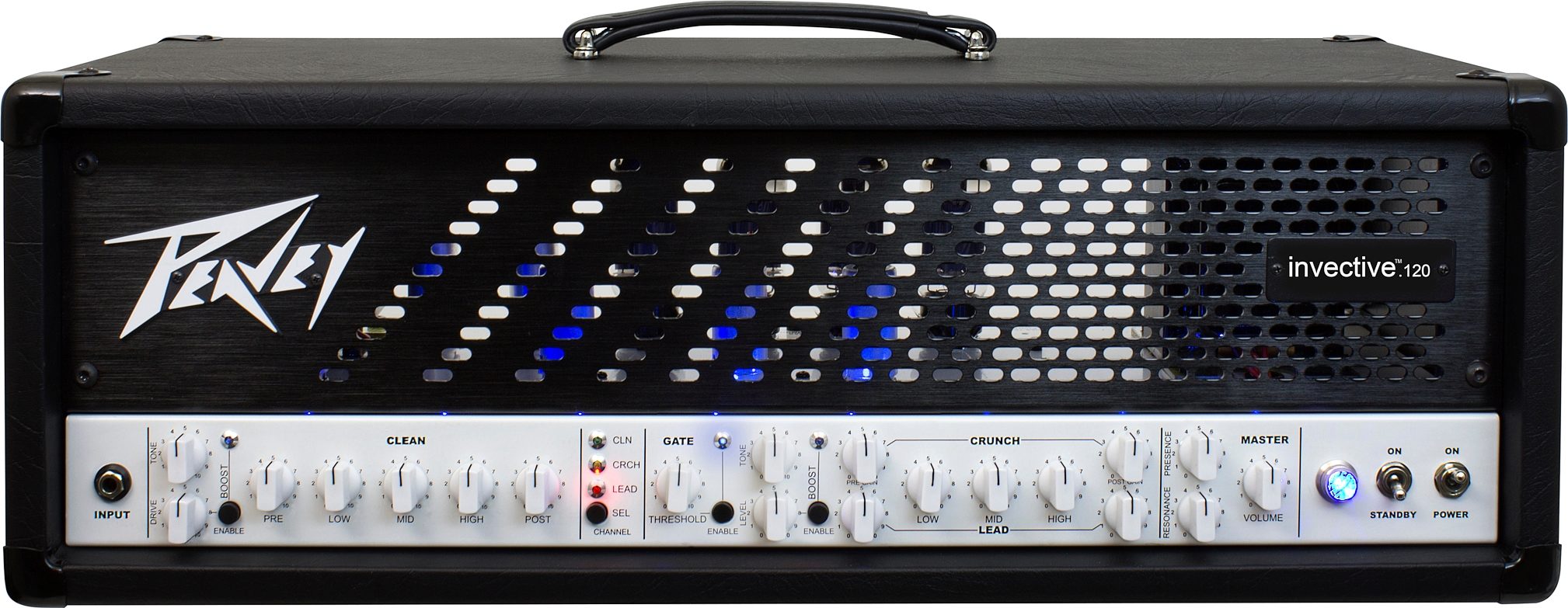
Peavey Invective.120
Where do I even start with the Invective.120 amplifier? It’s a dream come true, a Peavey 5150 reworked for today’s music, the most feature-rich amplifier I’ve ever seen without leaving the realms of being practical. The lead channel records incredibly well for heavy metal guitars. In the room, it lacks a lot of low-end, but this just positions the guitars better in the song up-front, making heavy-handed filtering unecessary when mixing.
All rhythm guitars in “Burnout” were recorded with the Invective.120 on the lead channel. The built-in gate within the amplifier was used selectively depending on the song section, and it’s the only noise gate used on guitars.
Zilla Fatboy 2×12
My custom Zilla Fatboy cabinet is still one of the best guitar cabinets I’ve ever had the pleasure of playing. “Burnout” makes use of its mixed speaker configuration: a majority of the rhythm guitars are an SM57 placed over the Celestion G12-H75 creamback speaker, but the sharper rhythm guitar layer heard in choruses and the second verse is another SM57, placed over the Celestion Vintage 30. Employing different speakers in this manner diversifies the guitar sound so that in mixing, less moves have to be made for each guitar to have its own space.
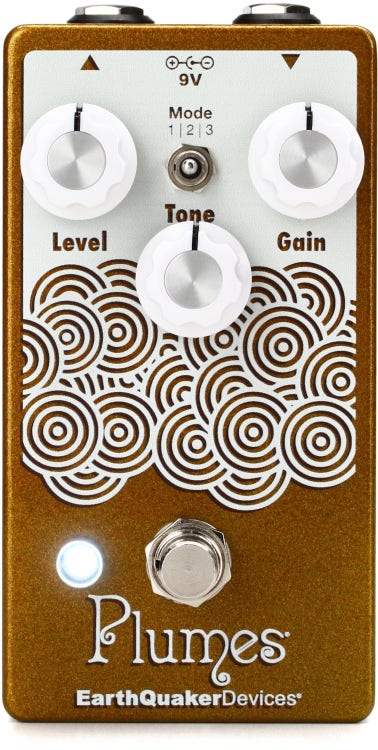
EarthQuaker Devices Plumes
Yeah yeah, I used a Tube Screamer-style overdrive. Unfortunately, “Burnout” was recorded in the dark ages when the Opaque Drive was just a bunch of components on a breadboard, unfit for recording. There’s a couple overdrives built into the front of Invective (also Screamer-style), but the EQD Plumes capitalizes on liveliness and tightness without overly emphasizing the typical Tube Screamer mid hump. All rhythm and lead guitars featured the Plumes in the conventional “minimum gain, high level, tone-to-taste” configuration (high level still being just over 9 o’clock on this device!), with clipping mode 1 engaged.
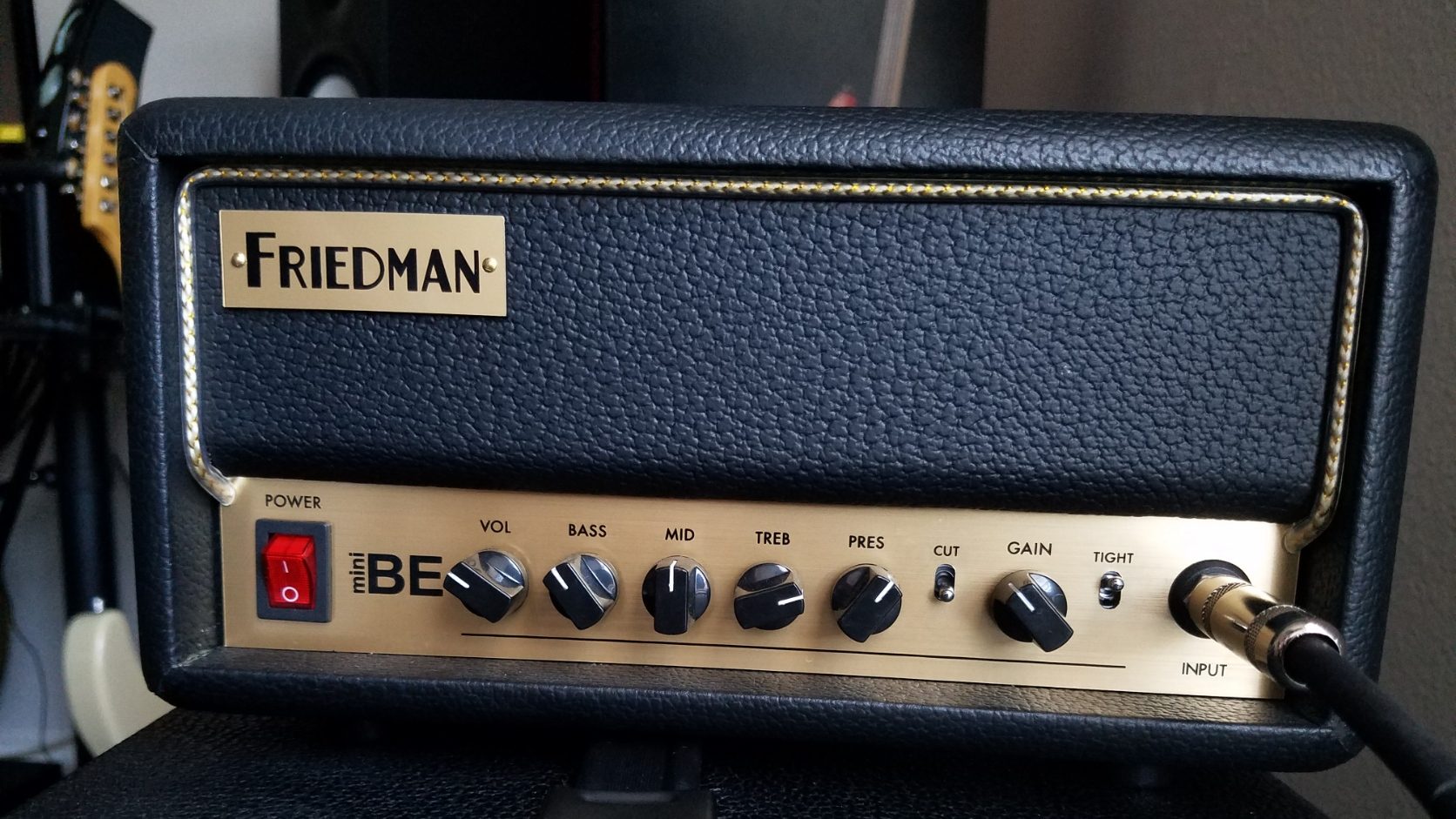
Friedman BE Mini
Another one of my favorite toys, back at it again! “Burnout” uses a recording technique I’ve admittedly stolen from the band Periphery. When I record rhythm guitars, I’m typically running the bridge pickup of my guitar into an overdrive pedal (i.e. the Plumes), and then a 5150-styled amplifier (i.e. my Invective.120). If you switch from the bridge humbucker to parallel single or split coils, you trade out your punchy, saturated rhythm guitar tone for a percussive, scooped (dare I say spanky?) tone with more pick attack and a little less gain. It’s a cool sound, and I’ve been using it for years (“Maximilian Andersocks”, “Breather”, etc.) Thing is, doing this with the Peavey 5150/6505/Invective family of amplifiers can sound a little harsh.
Periphery often records with the Axe-Fx modelers, and when they switch their pickups to parallel coils, they also switch their Axe-Fx patch to a copy of their typical rhythm guitar patch, but with a different high-gain amplifier. I’ve found that the BE Mini doesn’t share the same harsh nodes that the Invective does for this pickup configuration. So, when the rhythm guitars start in the electronic build-up section of the song, you’re hearing the same recording rig, but I’ve traded out my Invective.120 for the tiny BE Mini. Nifty!
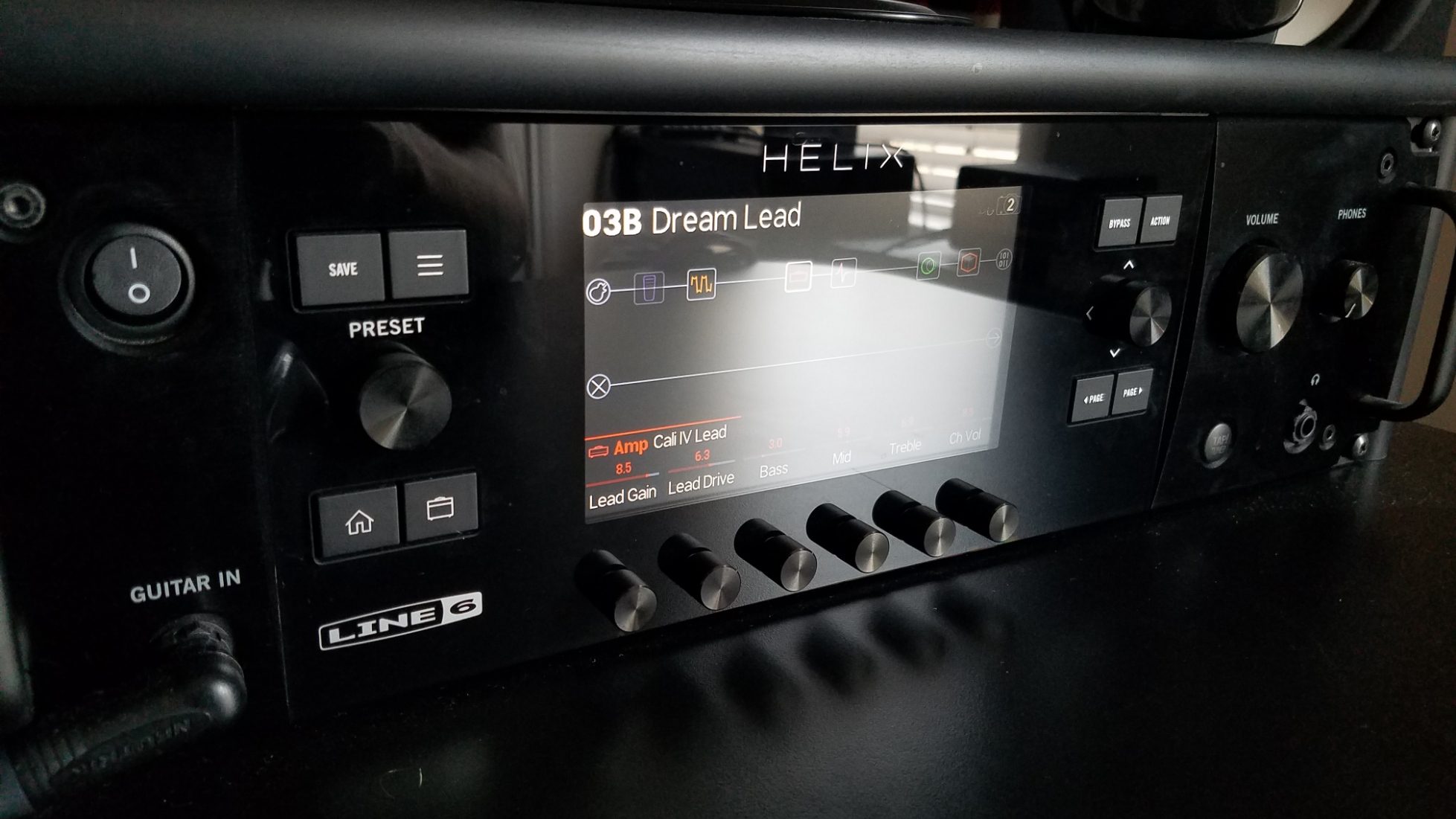
Line 6 Helix
As is usually the case, my Helix gets a lot of action tying up all the odds and ends of the guitar tones. The Helix handled all the clean and lead guitars for “Burnout”, but the most notable is the chimey effect-laden clean guitar heard throughout the song. This tone is my take on the “Milton Cleans” djent guitar tone made popular by bands like TesseracT and Monuments. It’s built around the Fender Deluxe Reverb model, with a high octave in front of the amplifier, and a parallel modulated reverb/stereo delay path behind the amp. Placing delay and reverb in parallel rather than in series prevents the reverb from smearing the individual repeats of the delay. The unique spin of the patch is balancing the gain of the amp model so that the setting takes on drastically different sounds with different pickups. “Burnout” used this tone with a hot neck humbucker.
Brainworx bx_bassdude
It seems that my bass tone varies with each release I do. The “Art Imitates Life Imitates” bass tone was an irreplicable and highly esoteric Helix patch. “The Jump To Nowhere” was a modern parallel processing chain featuring a wildly overdriven Vox AC30 emulation by means of Aurora DSP’s Mammoth plug-in. My favorite recording chain was the one used on “Herald” which consisted of just a Darkglass B7K Ultra pedal. “Burnout” was recorded before “Herald”, so I hadn’t quite gone with the simple B7K solution yet, so the recorded tone is all software plug-ins, centered around the Brainworx blonde Bassman emulation.
The Bassman is a bass amplifier legendary for taking on the role as a guitar amp, and that’s how I tend to use this particular plug-in as well. When searching for a bass tone for “Burnout” (and another, soon-to-be-released song), I wasn’t finding myself loving the standby SVT-based sounds. I tried the Bassman amp on a whim, threw on a 8×10 cabinet IR behind it… and it clicked! An instance of FabFilter’s Saturn was placed in front of the amp plug-in for pedal-style distortion, and that’s a majority of the sound as you hear it!

“Burnout” can be heard on all streaming platforms!
 Substation Onyx
Leave a comment