

My largest undertaking to come to light in 2023 was my collaborative album with my friend Shane Zahradnik, called “The Jump To Nowhere”. Written in parallel to “Art Imitates Life Imitates” and recorded and produced shortly after, “The Jump To Nowhere” is a progressive metal album that pulls from djent, progressive metalcore, and electronic music from video games. If any of that interests you, read on to see the tools that made it possible!
PRS Mark Holcomb SVN
The Jump To Nowhere used almost exclusively 7-string guitars for this record, in one of two primary tunings. The first tuning is Drop G#, which is D# standard on a 6-string guitar with a low, seventh string tuned to G#. For this we used a signature version of PRS’s SVN with high-powered ceramic humbuckers. This guitar records with relatively even dynamics and the pickups split well, so it was used for rhythm, lead, and clean guitars on all Drop G# songs.
Fernandes Revolver 7 Ltd.
The Jump To Nowhere’s secondary 7-string tuning has its roots in the DADGAD open tuning made popular by players like Jimmy Page. This tuning approaches electric bass range with the lowest string being the F on the low string on a 4-string bass. As such, it takes a very special instrument to not only handle the low tuning, but to sound great in that role.
My Revolver is definitely an oddball in my collection. It features a through-body neck, a 28-inch neck scale, and Gotoh tuning machines. While these are all modern appointments for a high-end metal machine in today’s guitar market, this guitar is well over 10 years old. This paints my Revolver as a sort of “proof-of-concept” guitar. The guitar does feature a few odd appointments that separate it from a modern metal baritone, such as the vintage-style Tune-O-Matic bridge and the stock EMG 707 pickups (I swapped these out many years ago for more conventional Fishman Fluence Moderns). The Jump To Nowhere recorded “Capture the Groove” and “Uh Oh, Collapsed Dynacoil” with this guitar in lieu of using an 8-string guitar.
Line 6 Helix
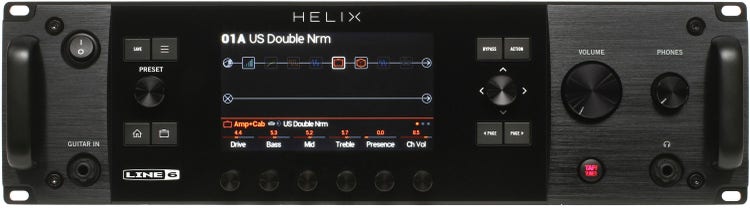
The guitar parts on “The Jump To Nowhere” are divided into two parts: rhythm guitars and all other guitars. Rhythm guitars were recorded on my Line 6 Helix, using my signal flow chain as it was in the summer of 2022 when the recording sessions took place:
- Input gate: Set with a moderate threshold and slow release time, this gate is meant only to dispel the noise floor that comes from the guitar.
- Horizon Devices Precision Drive: This Screamer-style overdrive is multi-functional in its role; in addition to a low-gain, high-level boost, it also has an active high-pass filter to eliminate flubiness of extended-range instruments, and a noise gate to further tighten the sound coming out of the pedal.
- Peavey 5150: This amplifier is a standard for a reason! With the gain set reasonably low, this amplifier balances saturation and crunch for a great modern metal tone.
- 4×12 Cabinet: This cabinet was on the now-legacy Helix cabinet simulation engine, and it was focused around huge-sounding 4×12 cabinets loaded with Vintage 30 speakers. A blend of microphones was also used, but you can’t go wrong with an SM57 for this sound!
- Parametric EQ: I’m not advocating for “mix-ready” guitar tones, but there are some things that can just go. I like to remove a smidgen of mud around 280 Hz and cut a little of the classic 5150 hiss at 4.1 kHz. Neither of these cuts exceed -2 dB. Another important move is to set the LPF to 19.5 kHz. While this may not seem like a huge deal, I find it subtly removes the strange-sounding high-end that is not faithful to a real tube amp and speaker cabinet.
Peavey Invective MH
With the rhythm guitars delegated to the digital realm, a tube amplifier was used to handle most of the clean and lead guitars. The Invective MH has its roots in the Peavey 5150, but its feature-rich lead channel and overhauled clean channel set it apart from its 1990s predecessor. This amp doesn’t have as much low-end girth as its 120-Watt big brother, but this plays well into using it for leads and cleans. It also has an abundance of high-end, so it always cuts through the mix.
My Personal Pedalboard
Guitar pedals were placed in front of the Invective MH to accomplish a wide variety of clean and lead tones. Almost all lead tones went through the Reaper Pedals Pandemonium overdrive. A Walrus ARP-87 delay was used in front of the Invective MH to create smeared, messy lead tones, which are great at sitting underneath busy rhythm guitars. All clean tones went through the Bogner Harlow compressor/boost, with the Pandemonium almost always being on as well to add a tiny bit of grit to the clean tone. Adding subtle amounts of distortion to clean tones using an overdrive is one of my favorite ways of preventing thin-sounding clean tones in a mix. The ARP-87 and Walrus Fathom reverb were also used to supplement clean tones as needed.
“The Jump To Nowhere” can be heard on all streaming platforms!
 Substation Onyx
Leave a comment