
2024 is off to a fast start with my newest song! “Crash” was written and recorded in the back quarter of 2023, and it’s crammed full of chaotic riffs, high-gain leads, and layered synthesizers. This song is a lot of fun to hear and play, so it only makes sense that it was a lot of fun to create! Here’s the highlights from the tools that brought you “Crash”:
Gibson Mach-III
Full disclosure: I am not Gibson guitars’ biggest fan, but this guitar is one of the most incredible instruments I’ve ever played. It’s got the thinnest next on the planet, the goofiest wiring scheme I’ve ever seen, and a sick reverse Explorer headstock. The history of these things isn’t detailed super well; Gibson launched them mere minutes before grunge stomped glam metal into the ground, and so these flashy, shred-tastic guitars (built for the latter) have been mostly forgotten about.
My M-III keeps an incredible Gibson 500T “Super Ceramic” pickup in the bridge position, and it’s well-suited for punchy, chuggy riffs. Every guitar you hear in “Crash” is the M-III’s bridge position humbucker with the exception of the clean guitar near the front of the song, which is the middle pickup.
Mixed Amplifiers
While this isn’t a standard move for me, it worked for this song! “Crash” is partially quad-tracked; two far-panned guitars playing the main rhythm guitar parts of the song, and two more guitars panned slightly more inwards that either double the first two guitars or play a supporting rhythm guitar part. To create a more diverse sonic landscape and prevent these two pairs of guitars from completely melding into each other, a different amplifier was used for recording each pair.
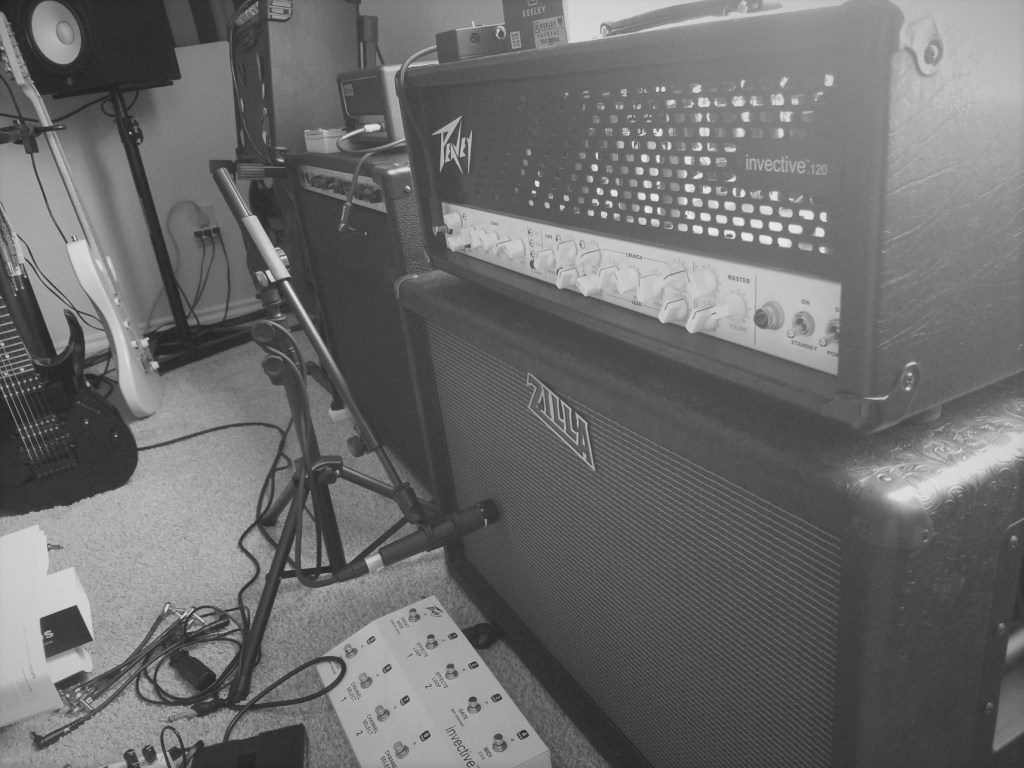
The primary rhythm guitars were played through a Peavey Invective.120 guitar head, on the lead channel, boosted with an EarthQuaker Devices Plumes. This amplifier’s lead channel is a little on the thin side, but this makes it more well-behaved in a metal recording scenario.
The secondary rhythm guitar pair was amplified by my modified Peavey 6505+‘s lead channel. This 60-Watt amplifier’s lead channel has been one of my staple rhythm guitar sound for many years now, and it definitely didn’t let up on this song. It has a perfect amount of thickness, attack, and saturation.
Blended Cabinets
Blending cabinet sounds is pretty common for me, but for “Crash” I experimented with cabinet and speaker blending in a new way: individual guitars now are going through blended speakers, specifically an old 90s Vintage 30 housed within my 6505+ combo amp’s 1×12 speaker enclosure, and a mint Vintage 30 in my Zilla Fatboy 2×12. Despite both of these speakers being Celestion Vintage 30s, the older speaker has a much smoother top-end, and the enclosure accents the lower end of the speaker’s frequency spectrum. Combining the speakers in a trade-off fashion in my DAW creates a mid frequency boost/low-end shift dynamic on a single control.
Drive Pedals Galore
I was struggling to create additional guitar parts for “Crash”. I wasn’t feeling inspired, and I was also finding that it was very difficult to fit meaningful notes over the busy rhythm guitars. So, I turned to a new approach.
I’ve heard lots of folks describe guitar pedals as inspiration boxes. I don’t entirely identify with this philosophy; guitar pedals, along with every other part of the rig, are tools. I tend to only reach for a pedal when I need a specific job done. However, while recording “Crash” I had a few loner pieces floating around in my room, so I set up my Helix to emulate a MESA/Boogie Lonestar amplifier (one of my favorite pedal platforms), and I grabbed a handful of pedals to try and create different sounds. Here’s what I ended up using:
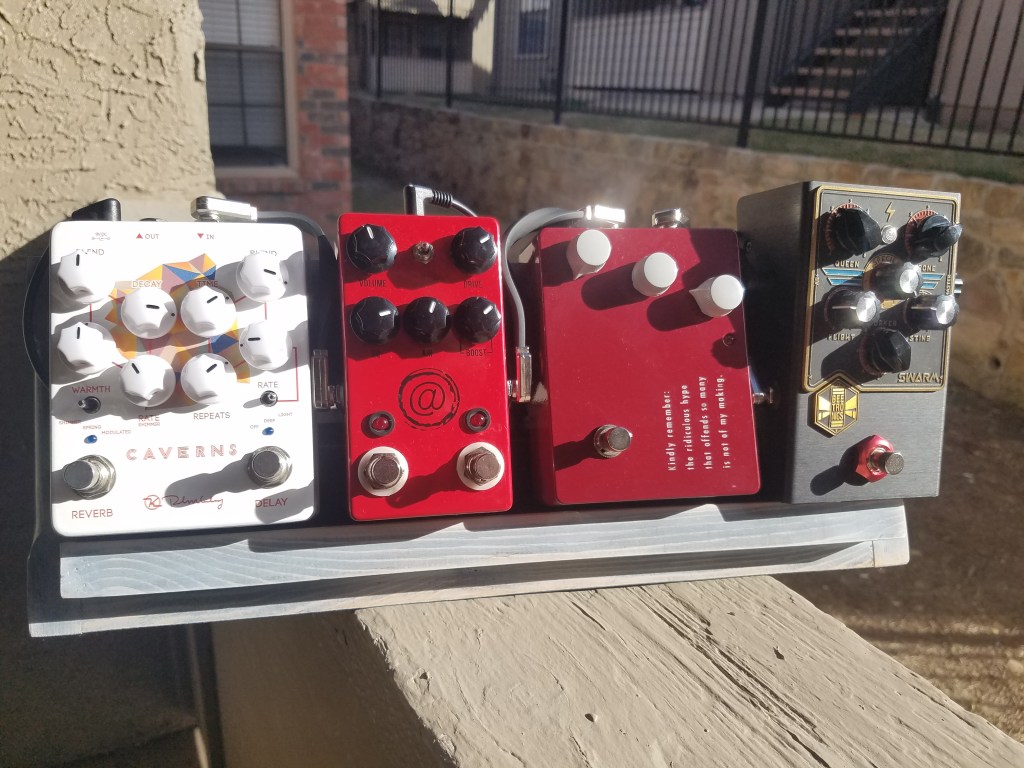
- JHS AT+: This is without a doubt the finest distortion pedal I have ever played. When in the high-headroom mode and with the vintage-style boost engaged, I could have easily been convinced that I was playing through a Marshall JCM800. This pedal got used for half of the lead guitar tones.
- Beetronics Swarm: Those who know me know my general unappreciation of fuzz pedals, but this thing is stand-out. It ONLY sounds like an angry machine, whirring up dozens of whinny electric motors. It only does the one trick, but it’s a HECK of a trick. This pedal got used for the lead guitar parts that consisted of drone notes or took advantage of the Swarm’s super slow pitch tracking for effect.
- Klon KTR: It may be THE most overhyped pedal on the planet, but it does a job and it does it well. I set this up with my typical “always-on” settings: low (NOT OFF) gain, medium-high treble, and level for unity volume. This keeps clean guitars a little fuller, a little brighter.
- Keeley Caverns: Don’t leave home without it! This flexible two-in-one provided the general delay and/or reverb sounds heard on each clean and lead guitar. The Caverns holds some of my favorite delay and modulated reverb sounds, in addition to a plenty of other super useful tones. One always lives on my desk, with light modulation on the delay side and the reverb side in modulated mode (I used the shimmer mode for “Crash” as well).
Brainworx bx_oberhausen
This was my first synthesizer, and how I learned synthesis. I’ve created a multitude of arpeggiators, pads, lead synths, and even e-drum kits with this plugin, so it tends to be next-in-line for creating layers in music after I feel like I’ve exhaused the electric guitar. This Oberheim emulation is used for stuttering synth sounds throughout “Crash” and it is also used for e-drum and lead sounds in the electronic outro section.

“Crash” can be heard on all streaming platforms!
 Substation Onyx
Leave a comment