
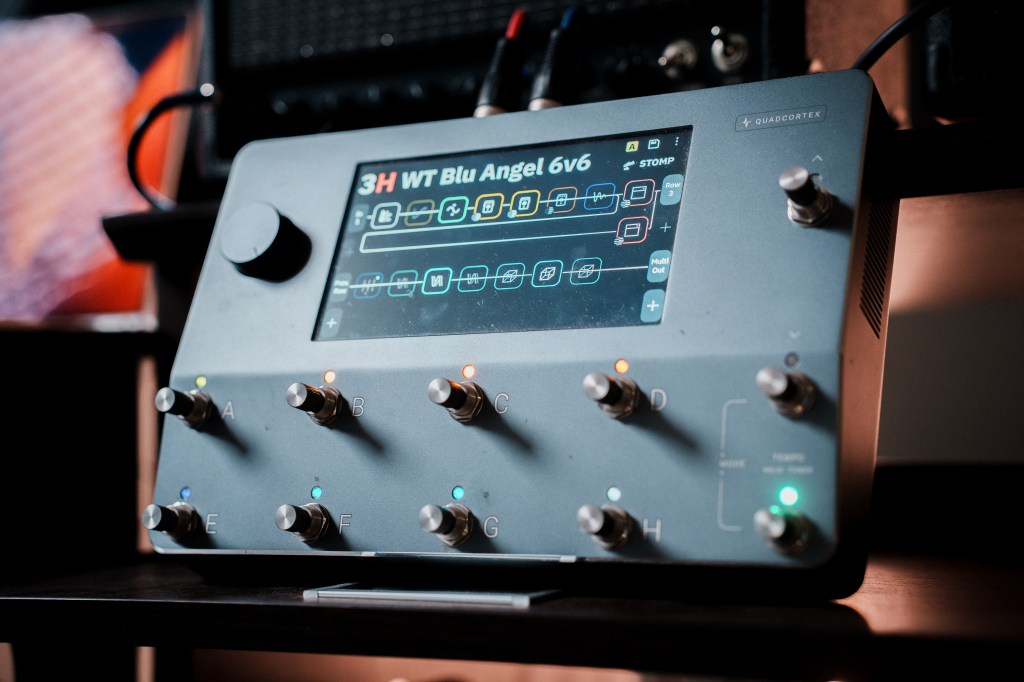
The amplifiers and pedals of Substation Onyx are now available for free through Neural DSP’s Cortex Cloud! In this post I’ll be talking about some of my favorite captures we’ve made (which will be continuously updated) and where you can hear these sounds within music we’ve worked on!
Substation Onyx Opaque Drive
Our very own Opaque Drive‘s overdrive circuits have been captured to offer a uniquely aggressive and balanced alternative to the existing pedals within the Quad Cortex model library. Lots of overdrives have a tendency to add a bit of compression along with any grit that they may impart, and the overall frequency response tends to include a hump in the lower mid-range.
The Opaque Drive’s Silver side has a broader mid-range shelf voiced a little higher than traditional overdrive pedals, and its unique clipping topology preserves your transients far more at lower gain settings (where the pedal was captured). Of the three voicings available for Silver, Classic and Full captures have been made. The Gold circuit does include a conventional, albeit broad, mid-range hump, and has been profiled at its Soft and Boost voicings, which correlate to different distortion flavors. Both drives are LOUD, and their captures reflect this!
Aric’s Modified 6505+112
A very specific sound tends to pop into most folks’ minds when they think of a Peavey 5150/6505. Our resident 6505+112 is perhaps the farthest you could stray from that majority view without loosing the archetypical sound altogether.
In comparison to the larger 6505+ amplifier head, the 6505+112 is an abridged, half-power (60 Watt) combo amplifier. Though not widely known, the iconic lead channel is actually factory-modified to severely reduce the upper-mid hiss that these amps are notorious for. This results in a slightly less-saturated, crunchier, and somewhat darker amp.
Furthermore, we’ve performed a series of mods on this amp ourselves! The rhythm channel is revoiced for more bass, a different flavor of distortion, and a British tone stack. The power amplifier has also had its resonance peak shifted downwards. We’ve taken three captures of the amplifier directly, so you can use whichever speaker you want!
Friedman Wildwood 20
The Wildwood 20 is a bit of a secret weapon. Made exclusively for Wildwood Guitars by Friedman Amplification, this amplifier is an EL84-based 20-Watt, two-channel take on the legendary BE circuit. The primary channel is taken from the BE DLX and comes with several of the same switchable voicings. The secondary channel is a one-knob (volume) clean channel reminiscent of a VOX AC, with three options for bright caps. The result is essential British tones (with power amp break-up!) at less-than-earshattering volumes. We’ve made captures of several configurations of the BE channel, along with a few captures of the clean channel.
Bogner Uberschall Mk2
The so-called “Uber Ultra” is a two-channel amplifier that builds upon the smooth, liquid gain of the original Uberschall but introduces a high degree of per-channel configurability, similar to Friedman BE amplifiers. The first channel is capable of anything from spanky clean tones to high-gain crunch, and the second channel begins well before the first channel leaves off, resulting in a high amount of tonal overlap between the channels. As such, either channel is capable of the infamous high-gain Uberschall sound. We took several captures of each channel of the 100-Watt EL34 version.
Our captures can be found over on our product page, along with a few patches, including our modern metal bass guitar signal chain, a recreation of our vocal tracking hardware, and a stepped-delay synthesizer!
 Substation Onyx
Leave a comment